Deep tech engineering · Metal 3D printing from Tettnang, Germany
Rethinking metal components.
When conventional manufacturing is too slow, too expensive or too rigid in design, we print metal components from wire. Near-net-shape, without tooling and on machines we developed ourselves.
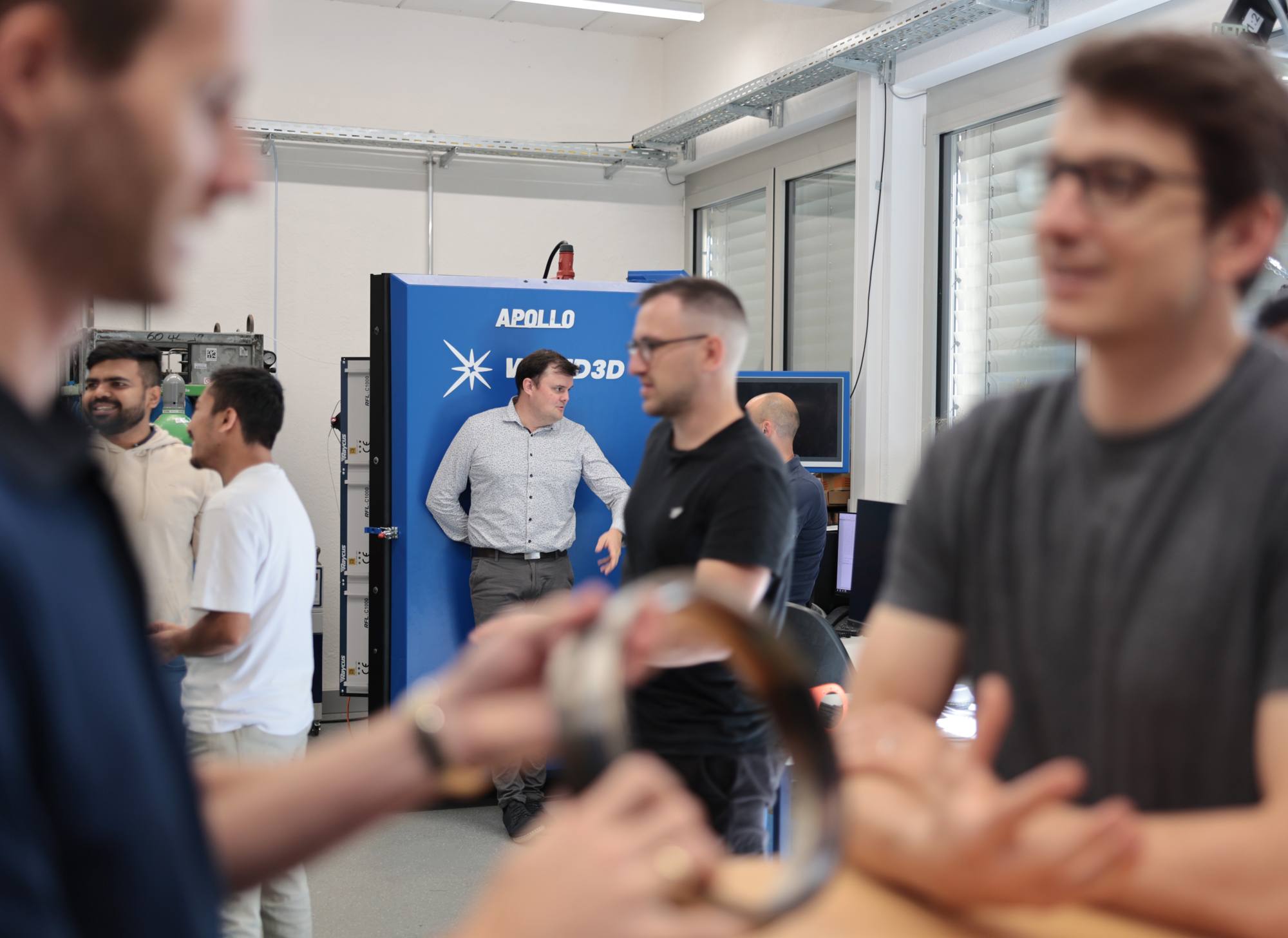
At a glance
Not just manufacturing differently. Deciding better.
WIRED3D is your development partner for the metal components of tomorrow. As a technology-driven company with roots in research and industry, we support you from the first part idea to a production-ready manufacturing strategy.
Printing is never an end in itself. It pays off where a component, its function or its supply chain deserves a fresh look. We assess these opportunities systematically and tell you when conventional manufacturing is the better choice.
Available sooner
Parts in weeks instead of months. No mould, no tooling, even without a drawing if necessary.
More design freedom
What used to be welded from many parts or milled from solid is built in one piece, with features that conventional methods cannot deliver.
Our own technology
We develop the machine, control system and path planning ourselves. That is why we adapt the process to the part, not the other way round.
The starting point
Does this sound like your part?
Many parts are made the way they are because they have always been made that way. That often makes sense, until requirements, quantities or supply chains change.
- The casting mould no longer existsPattern lost, foundry gone, demand remains.Spare part
- A forging die doesn't pay offFor small quantities the tooling is too expensive.Tooling costs
- The batch size is too smallTooling costs dominate the unit price.Small series
- Every variant needs its own toolHigh part variety eats up time and budget.Variants
- The assembly has too many weldsMany individual parts, interfaces and sources of error.Welded assembly
- 80 to 95 % ends up as chipsMachining from solid takes time and wastes material.Machining
- Demand is irregularStorage is expensive, reordering takes too long.Digital inventory
- The supply chain is too complicatedSingle source, long routes, dependence on non-EU countries.Resilience
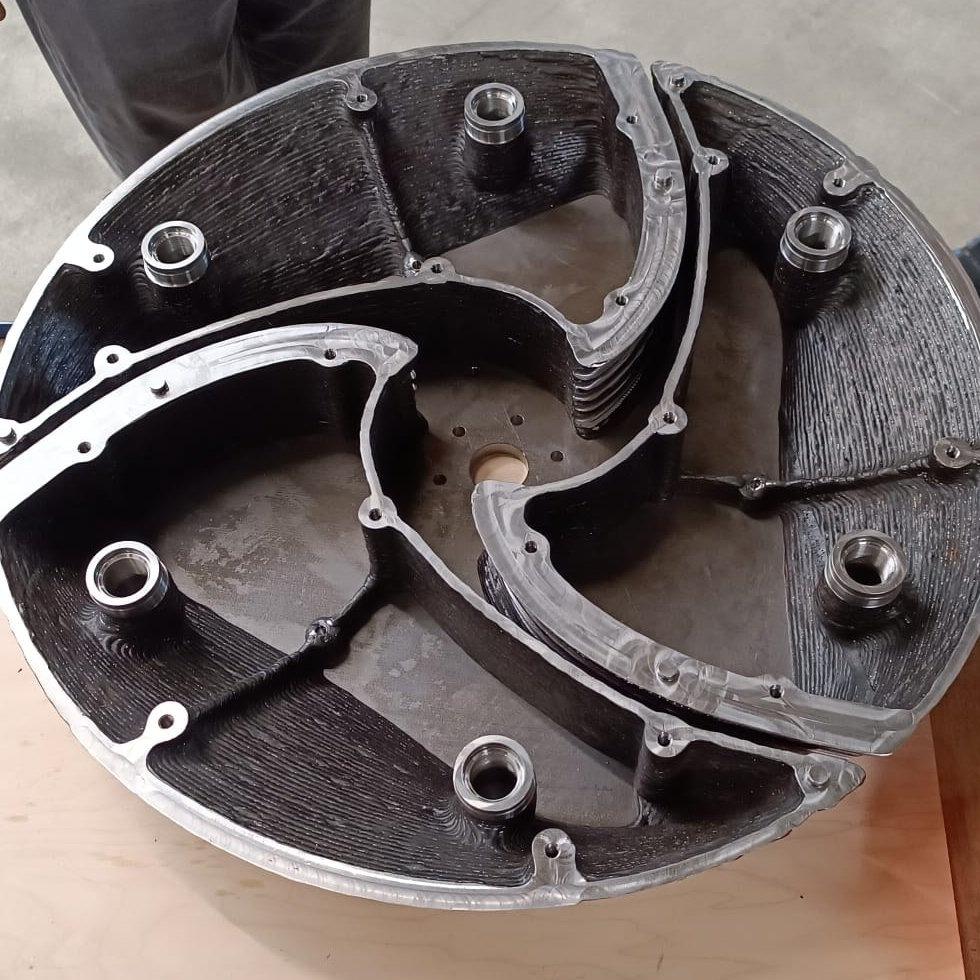
Reference · Replacing a sand casting
Peeling wheel: three printed segments instead of pattern and mould.
Fine-grain steel, Ø approx. 750 mm, functional surfaces machined. Initial procurement compared with sand casting:
Free Innovation Check
What potential does your part have?
Additive metal manufacturing opens up new possibilities: parts can be redesigned, functions integrated, weight reduced or several components merged into one.
You send a drawing, CAD data or the part itself. We assess feasibility, lead time and economic potential and tell you frankly whether printing is worth it.
Welded bearing bracket assembly
Today: assembly of 8 welded parts. Additive: 1 part, functional surfaces machined.
- Welds eliminated
- Fewer parts and stock items
- Local wear optimisation possible
- Potential for a multi-material build
Illustrative example, not a customer project. Each criterion rated from 1 to 10.
Component range
From castings to welded assemblies.
With DED 3D printing we cover parts that are cast, forged, milled or welded today. Even combining two steels in one piece.
For engineering, purchasing and management
A technology project needs a reason.
The question is not just whether a part can be printed. What matters is whether the new route makes a real difference and whether effort, risk and benefit are in sensible proportion.
Function, weight, integration
Several parts become one. Cooling channels, hollow structures and local wear zones are created directly during printing.
- Merge assemblies into a single part
- Wall thicknesses that follow the load path
- Two steels in one part: tough core, hard shell
- Integrated fluid and cooling channels
Procurement starts long before the quotation
Anyone responsible for availability, cost and supplier risk needs alternatives before things get tight. Metal 3D printing creates a second manufacturing route.
- Availability and resilience for hard-to-source or discontinued parts
- Independent of tooling, foundries and suppliers outside the EU
- Leaner supply chains with fewer parts and suppliers
- Wire feedstock is standardised and available from many manufacturers
Maintenance, spare parts, downtime risk
Availability instead of downtime: spare parts are kept as approved data sets and only made when they are needed.
- Longer service life for existing equipment
- Replacement even without a drawing, via 3D scan
- Production on demand instead of stock
- Go to the digital spare parts warehouse
Don't just compare the printing price
Whether additive manufacturing is cost-effective cannot be judged from geometry or unit price alone. A fair comparison looks at the same function with the same quality requirements.
- Part and quantity: annual demand, batch sizes, life cycle
- Current costs: tooling, procurement, assembly, storage
- Process chain: printing, heat treatment, machining
- Result: a basis for decision-making instead of a technology promise
Customers, partners and funders
In good company.








Start with the Innovation Check
One part. One question. One sensible next step.
Let's find out together whether additive metal manufacturing adds real value to your part. Free of charge and confidential.